

What Is a Micro Studio?
A breakdown of ideas for a micro-budget, NonDe studio structure that can sustain small teams with evergreen stories, branding, and IP.

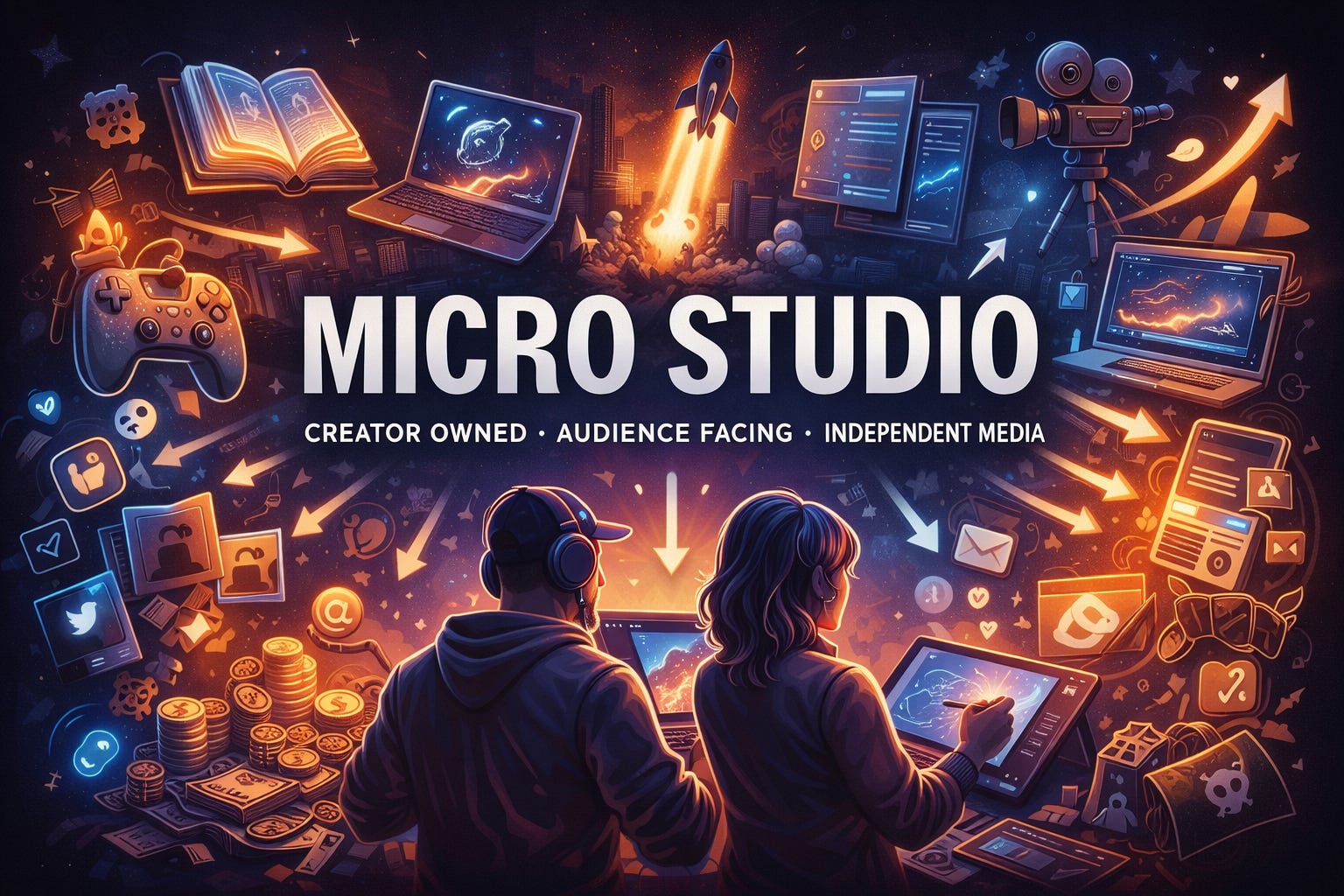
What Is a Micro Studio?
Over the last two years, we’ve been quietly building toward a different kind of filmmaking model. This model is designed for small teams, owned IP, and direct connection to audiences.
I’ve seen a lot of similar conversations and manifestos on FilmStack and the NonDe space lately, so I wanted to share the framework we’ve been developing and see if it resonates.
So, this week I wanna talk about THE MICRO STUDIO.
Core Thesis
A Micro Studio is a creator-owned, audience-facing media business.
Traditional Hollywood is built on a B2B system. One business owns the rights. Another business makes the movie. Another company markets it. Another business distributes it to the masses. With a bunch of percentage claims for various middlemen along the way.
A Micro Studios is built as a B2C (direct-to-consumer) business. Whose only job is to make badass stories people love and then make it easy for them to find.
This model is designed for small teams (1–10 people) who want to own their IP, work long-term, and build sustainable creative businesses — not for one-off films chasing weekend recoupment.
For Context: As we test this theory and fine-tune this strategy, we’re building a 3D/AI animation hybrid pipeline. Our team is made up of 2 people, a $5k budget, and gear we’ve gathered over the years. We’re both production generalists with producing, writing, cinematography, editing, and vfx backgrounds. Not sure how this would work for on-location specialist teams. But in theory… I think the same principles could be applied to any project.
General Ideas So Far
Sustain a small team. Where Hollywood studios have huge expense sheets, a small team that owns its own IP does not require as much cash flow to stay afloat. The aim should be to build our own business doing what we love.
Teams of 1 - 10: Contributors would need to bring multiple skills to the table. I suspect generalists will benefit from this model more than specialists.
Equal Equity: This is optional, obviously. But we’re choosing the path where small teams share equal equity in the business & Intellectual property. For larger budget projects, this may require limiting equity among core contributors, with structure depending on the project.
For us, each member holds an equal stake and vote in how those IP’s expand into the zeitgeist. In theory, this could build long-term income over time.
Right now, we’re testing the theory with a 2-person LLC. Ideally, an A-Corp might work better - but until that rolls out, we’re makin’ it work.
Financial Goal: The financial goal of a Micro Studio is simple: keep a core team of 1–10 people meaningfully employed by the stories they create, across multiple IPs, over multiple decades. Exact numbers of subjective to your team’s needs.
Money is generated through a mix of direct sales, AdSense, merchandise, live events, and selective licensing. We’re not building one-off hits or platform dependency. We’re building tangible IP for an audience.|
Sustaining a small creative team requires far less revenue than operating a traditional studio with massive overhead. Think mom-and-pop scale economics, applied to filmmaking.
This model works by limiting percentage cuts to middlemen wherever possible, keeping more of the upside distributed among the creators actually doing the work.
No Capital? Expect sweat equity. This is a side-hustle-with-a-plan, not a gig-for-a-paycheck. The long-term goal is to pay salaries to the core team, with profit participation layered on top — like any sustainable company.
Note: Right now, we’re testing how lean this can be. Our 2-person team is operating on sweat equity, supported by outside work, with the goal of proving a version of this model that can realistically support a small team over the next five years.
Creator Economy Ethos: While many filmmakers stick their nose up at creators and influencers, let’s not forget that creators and influencers are actively working, own their work, and can scale as big or as little as they desire. This model adds strategy to the wannabe influencer model and aims to build audiences for stories vs personality.
Instead of posting blindly and hoping for “viral videos,” each video, blog, story, reel, post, ad, etc is strategic in nature. Iterating on what works and doesn’t work on each individual platform is key to understanding what the product needs, the audience wants, and what you like doing. Each post is a test that should improve the craft of the next post.
The goal is to build stories, characters, and worlds. While identifying the best formats that allow an audience to find, engage, and expand in their preferred spaces.
Audience building is key to this model. If we’re not going to sell our films/ideas to studios with an audience anymore, we have to build our own audiences.
Distribute Wide. Micro Studios are their own Media companies. Meaning they need to leverage their own IP to sell directly to Audiences in various formats. Taking the playbook out of the “indie author” distribution strategy, we should aim to publish wide on every IP we build.
Make the story, characters, and worlds available across many different retailers, formats, and platforms.Books - Create a tangible product that your audience can hold, collect, and love. Books also open up opportunities to copyright and build source material if building projects in public.
Films as Webseries - Produce films in a way that allows for multiple 10-20min webseries episode drops. Similar to the Netflix format of eight 1hr episodes for an 8hr movie. Do twelve 10min webisodes for a 2hr movie. But also be able to cut the 12 webisodes into a 2hr feature-length film… that can also be released through aggregates where appropriate.
Games - According to google 3.2billion people worldwide play video games. 1.56 billion people play tabletop and card games. Adapting your stories into experiences your fans can engage with is a great way to expand stories, worlds, and characters.
Music - If you’re making your own music for your projects plan to make these a part of your product line. Because… Duh.
Merch - If the folklore of Star Wars is true…merch is a HUGE part of your IP. Don’t sleep on it. Every piece is an additional asset that not only brings a fan closer to your story. But it also acts as a form of advertisement to those who don’t know about you yet. Conversation pieces are subtle hype your fans want - so give it to them.
Live Events - Live events include in-person events and online events. They form a collective experience that can pull audiences. It drives a deeper connection with the stories you’re telling and the people who love them. This can include screenings, tours, virtual events, and more.
Festival & Competitions - Pros of festivals lie in instant credibility, industry networking, and press opportunities. With the potential for validating a film in a market and attracting distributors. Cons lie in high cost, competition, and generally low visibility for indie films. Keep in mind, there are also free online film festivals and competitions that can be useful to spread narrative brands and awareness for your stories in more niche spaces.
Brand Building Focus - I know artists hate the idea of thinking of themselves as a brand, but if we’re not going to ride the coattails of legacy media’s brand, we gotta build one of our own. Remember, we’re building a Micro Studio, a business. And businesses need brand identity, brand participation, and brand presence.
Website Destination - Your website should be your main destination for all fans. While you’ll use other platforms to spread the word of what you create, your website will be the digital brick & mortar location they go to get what they want.
Social Media - Think of social media as the marketplace where people are. You’ll be visiting these places regularly and sharing what you do there. You’ll have a strategy that reminds them - your website has more cool stuff - they should stop by sometime.
Mailing List - I’ve resisted the mailinglist strategy for years. I hate junk mail, and do not wish to contribute to your junkmail. But, at the same time, mailinglists are essentially our newspaper boy delivery system. It’s how we get the latest news, but instead of getting news from everyone, it’s curated to the things we like. If they signed up, they’re interested in what you gotta say. Tell them everything.
Communities - Communities will form naturally on social media platforms every time you post something. You can build “Official” locations for the community through platforms like your website, Discord, Patreon or Kofi. These official interactions may require extra content, regular engagement, and delivering whatever it is you’re promising if you’re charging a membership for it.
TLDR, Core Values of a Micro Studio
A Micro Studio is a creator-owned media business built to sustain a small team by owning IP, building audiences directly, and distributing stories across formats.
It is not about scale, gatekeepers, or selling labor—it’s about long-term storytelling, ownership, and creative independence.
To be clear: Micro Studios are not about scaling headcount, selling labor, or handing finished work to distributors.
We own what we make.
We sell what we make.
We benefit from what we make.
Maybe that sounds naive. But my goal is simple: to tell stories people love enough to return to over a lifetime.
I want to build an evergreen studio around stories that can sustain a small team for the long haul - stories that are genuinely fun to write, animate, and bring to life.
The goal is longevity. Stories people return to. Worlds people care about. Work that sustains the people who create it.
If that idea resonates, I’d love to keep the conversation going. I’m here to talk shop with anyone trying to build something lasting. Let me know in the comments what you’re thinkin’.
That is exactly what I'm trying to build! I totally find myself in your model :)
The one difference is that my plan is to do everything within one urban fantasy universe ("The Hugoverse"): short stories on Substack, novels, web series, short vignettes. And of course, I write, direct and act (after all, I created Hugo in the first place mostly because I wanted a main character for myself ;)). All this while building the audience around Hugo and his magical world.
Very empowering but can’t help but feel the overwhelm creeping in!